Is AI-Moderated Research Qual or Quant? A CPG Insights Guide
Why AI-moderated research isn't a faster survey or a cheaper focus group — and what it's actually built to replace.
AI-moderated research is neither quant nor qual — it's a hybrid method that runs open-ended, adaptive interviews at quantitative scale, giving you the "why" at sample sizes surveys reach but focus groups never could. The bigger shift: it's not replacing your survey or your focus group. It's replacing your agency.
A month ago (an eternity in the world of AI) I was talking to a new client of Keplar and as part of my “spiel” I said that I viewed Keplar as a replacement for quant not qual, to which my client said “Well, Polina, we see you as a replacement for qual and that’s why we’re paying for Keplar”.
Awkward moment … but it got me thinking, and I’ve spent another month reading and experimenting. This led to this article and my current stance: AI-moderated research isn’t replacing qual or quant—it’s a new hybrid research method (alongside 1:1 interviews, surveys, focus groups, Wizard-of-Oz, etc.), and our mission should be to identify where it’s best applied while helping to define the best practices for designing AI-moderated studies.
Why all of us are confused
Keplar research is two distinct capabilities stacked together: AI moderation (an adaptive agent conducting the conversation) and agentic analysis (an agent synthesizing thousands of those conversations into themes, tensions, and decisions).
In typical Silicon Valley fashion, startups are loudly positioning themselves as a replacement for X (a limiting way to build a company). In reality, they are trying to decide whether the airplane is a replacement for the car or the cruise ship. It’s neither; it’s a bit of both, and it will inevitably change how we all travel to the most impactful decision.
Interestingly, the academic world has moved faster than the commercial one here. In their forthcoming paper in the Review of Economic Studies, LSE's Friedrich Geiecke and Xavier Jaravel describe AI-led interviews not as a faster version of qual, but as a tool that bridges qualitative and quantitative methods — running thousands of adaptive interviews at a scale that interviews have never operated at before. They benchmarked the method across four domains against trained human interviewers and found it performs at the level of a competent human expert in a 30-minute interview. A separate controlled study by Wuttke and colleagues, published at ACL in 2025, randomly assigned participants to either an AI or a human interviewer using identical guides and concluded the AI produced data quality comparable to traditional methods, with the added benefit of scalability. The same paper makes this point explicitly: the method now requires a comparable program of methodological research to determine best practices.
We're not confused because the technology is bad. We're confused because we skipped the step where we define the method.
Start where you always should: what job is research hired to do?
Whenever a new tool shows up, the lazy question is "Where can we plug it in?" I wrote about this exact anti-pattern last time — it's the same impulse that has every board deck screaming "add AI to it." The disciplined question, the JTBD question, is: what job is the customer hiring this for, and is this method the best candidate for that job?
For CPG and Retail insights teams, the ultimate Job-to-be-Done is boring and unchanging: make better business decisions that drive measurable business impact. And do it fast. Nobody hires research because they enjoy reading transcripts or flipping through decks. They hire it to de-risk a decision they're about to make with real money and reputation.
That top-level job decomposes into three levels, each with a different unit of focus — and this is the structure I'd anchor your whole insights operation on:
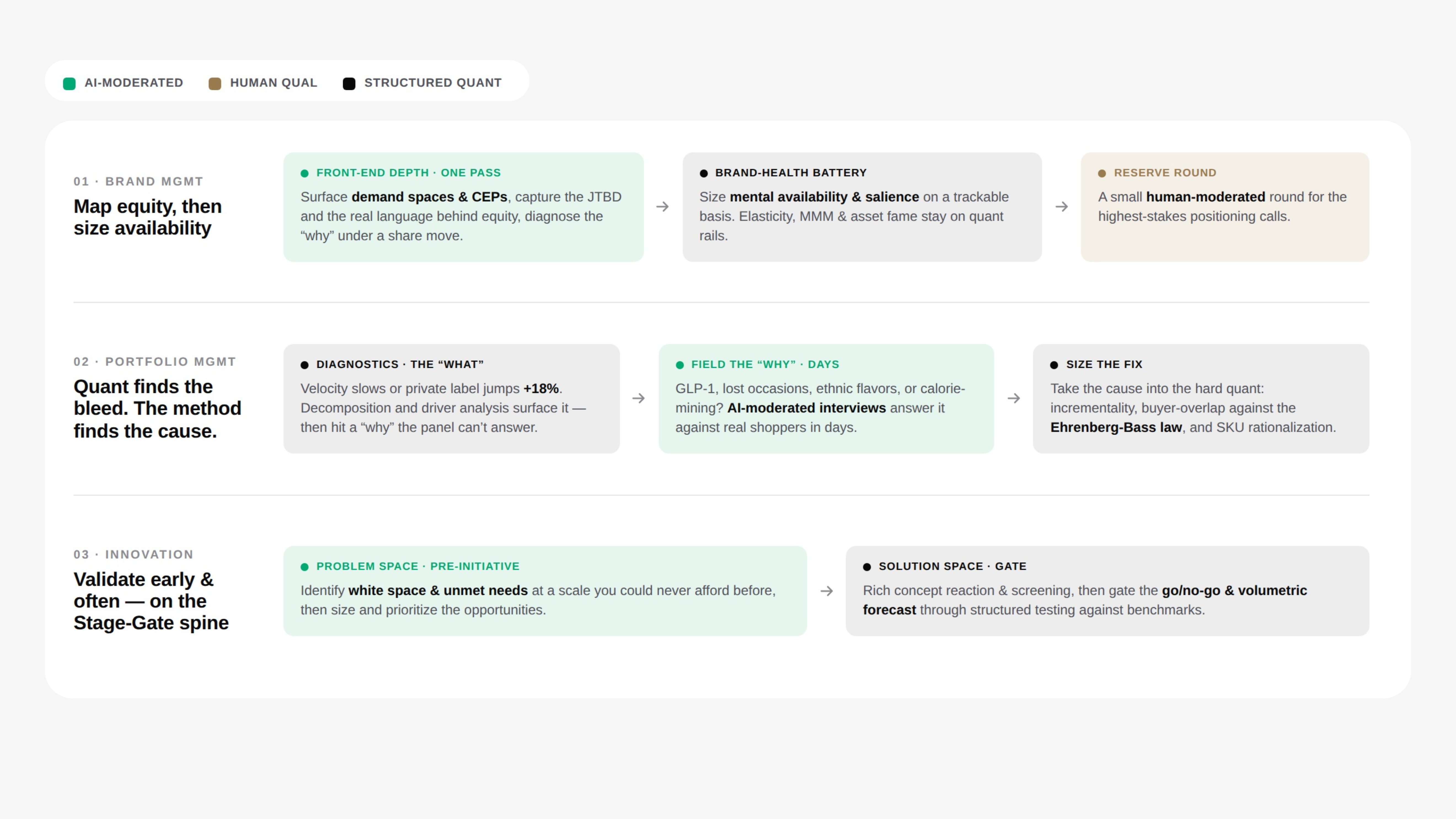
- Brand Management level: the jobs of building and sustaining a single brand. Category and demand-space understanding, CEP identification, JTBD, positioning and equity, brand health, distinctive asset development, claims and creative, packaging, pricing and value, and the "why" behind share and churn.
- Portfolio Management level: the jobs that exist only because the company owns multiple brands. The unit of focus is the whole and the interactions between brands: portfolio role definition, coverage and white-space mapping, the defining job of resource allocation (grow / maintain / harvest), and the interaction jobs that are unique to this level — cannibalization, incrementality, duplication-of-purchase (the Ehrenberg-Bass buyer-overlap law), SKU and brand rationalization.
- Innovation: the jobs of finding, building, and validating new growth, running on a Stage-Gate spine and cutting across both levels above. Front-end white-space and unmet-need identification, opportunity sizing and prioritization, concept generation, screening, and go/no-go testing, product and sensory testing, claims substantiation, and volumetric forecasting before launch.
One universal trigger worth naming, because it's where research demand spikes: dynamic disruption; inflation, recession, regulatory or channel shocks. These aren't standalone jobs; they re-activate and re-prioritize many of the jobs above at once (re-estimating elasticity, mapping trade-down, re-baselining segmentation) and, critically, they invalidate existing consumer evidence and force fresh research on a brutal clock. That last property matters enormously for method choice — when your evidence just expired and you need answers now, the economics of speed stop being a nice-to-have.
Each job hires research for a different reason, on a different clock, with a different budget. Which is exactly why a single yes/no answer to "should I use AI-moderated interviews?" is useless. The honest answer is always: for which job?
A reusable framework for CPG Insights teams: The Method - Job Fit Map
This is the framework I want every insights team to use. Stop debating whether AI-moderated interviews are "good." Start scoring fit against the specific job, on the two dimensions where this method genuinely wins or loses. Better yet, get your hands dirty and experiment fast. Push vendors for pilots, ask them to do the heavy lifting of setting them up, and see what you get back.
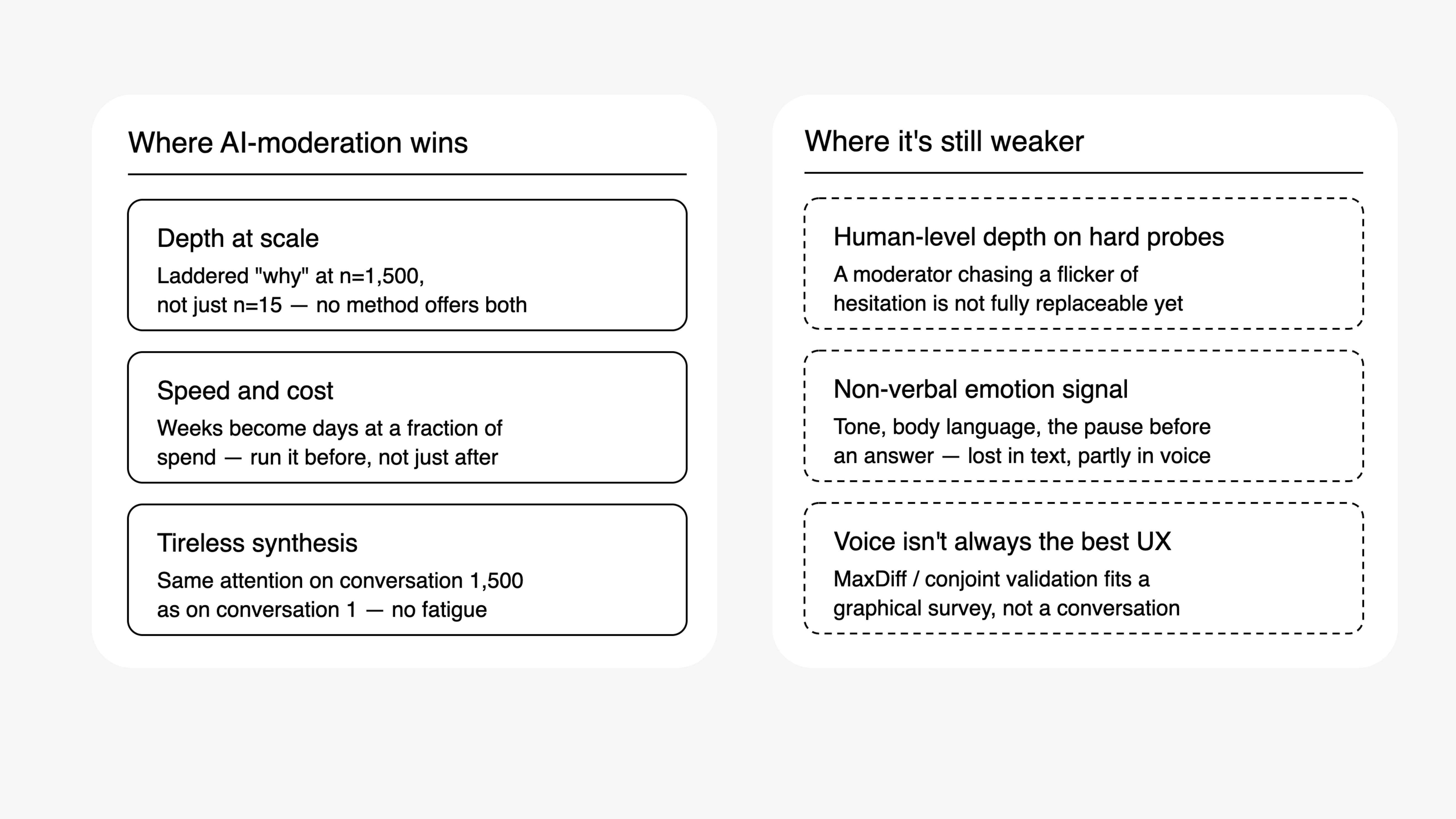
Where AI-moderated interviews win:
- Depth at scale. You get laddered, open-ended "why" — not at n=15, but at n=1,500. This is the combination no legacy method offers.
- Discovery and sizing: Most traditional methods focus on either open-ended discovery or close-ended quantification (with very structured, known questions). Keplar studies let you do both in one shot. Learn what you didn’t know, then also prioritize it.
- Speed and cost. Studies that took 4–8 weeks now land in days, at a fraction of the spend, which means you can run them before an initiative instead of only when the budget justifies it.
- Tireless synthesis. Agentic analysis reads every transcript with the same attention on conversation 1,500 as on conversation 1 — no fatigue, no "I only laddered the first ten."
Where it's still genuinely weaker (and pretending otherwise is how you lose client trust):
- Human-level depth on the hardest probes. The quality of follow-up questions is real but still uneven — a brilliant human moderator chasing a flicker of hesitation is not fully replaceable yet.
- Non-verbal emotion signal. Tone, body language, the pause before the answer — largely lost in text, partially recoverable in voice.
- Voice isn’t always the best UX for the participants: For a MaxDiff or conjoint, which is used for a final statistical validation and you’re not looking to get any qual data, it’s easier for a participant to use a graphical survey interface, not a conversation.
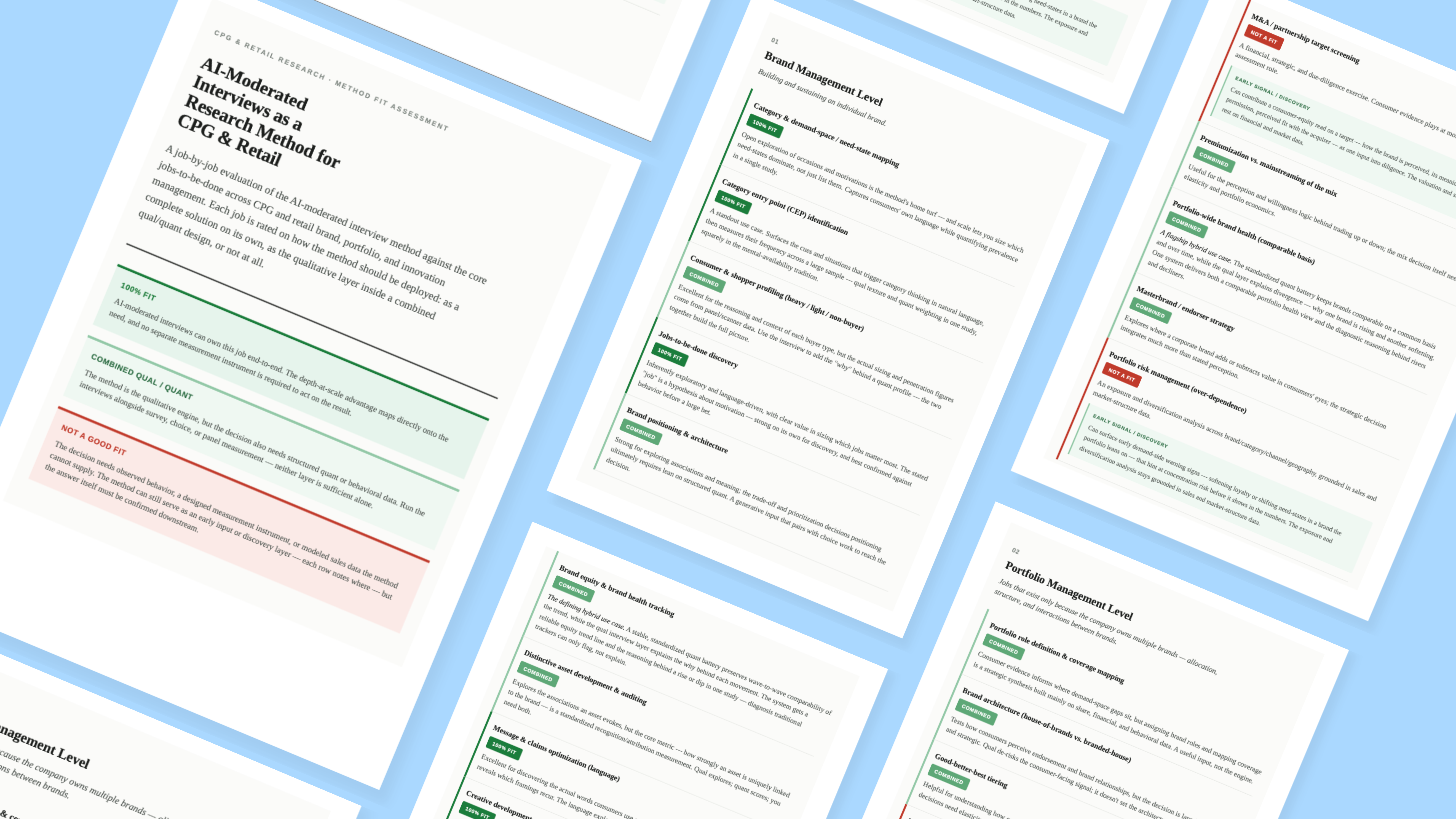
Mapping the best applications for CPG & Retail
AI-moderated interviews rate strongly wherever the job is to understand the why, surface language, and explore the unanticipated — and where doing so at scale adds the ability to size what's found. The highest-value is the diagnostic "explain the number" qual — performance diagnosis, churn drivers, the "why" behind a concept score. This is the qual most chronically amputated for time at decision gates and moments of change, and speed-at-scale is precisely what lets it survive the deadline
They aren’t the best fit rate wherever the job requires a different kind of data, one a conversation was never going to generate: observed behavior e.g. sales, distribution, cannibalization, findability, sensory delivery, legal substantiation etc. Note that this isn't a limitation for agentic analysis quality.
🔗Download the full map here across Brand Management, Portfolio Management and Innovation.
One massive shift: it’s replacing your agency.
To date, complex multi-step studies like CEP identification, demand-space mapping, JTBD, segmentation, and white-space discovery have been carried out by research agencies or consultancies.
This is where real disruption occurs. AI moderation collapses the cost of depth. Agentic analysis collapses the cost of synthesis. Furthermore, you can run studies in parallel instead of sequentially. When these three factors align, the economic rationale for the agency middle layer largely evaporates—allowing you to run studies in-house (or through agent-augmented full-service offerings) in days that used to cost six figures and take a full quarter.
Let’s walk through one example of a study for which CPG teams would typically pay an agency today: CEP programs (identify, size, and prioritize—in one parallel pass).
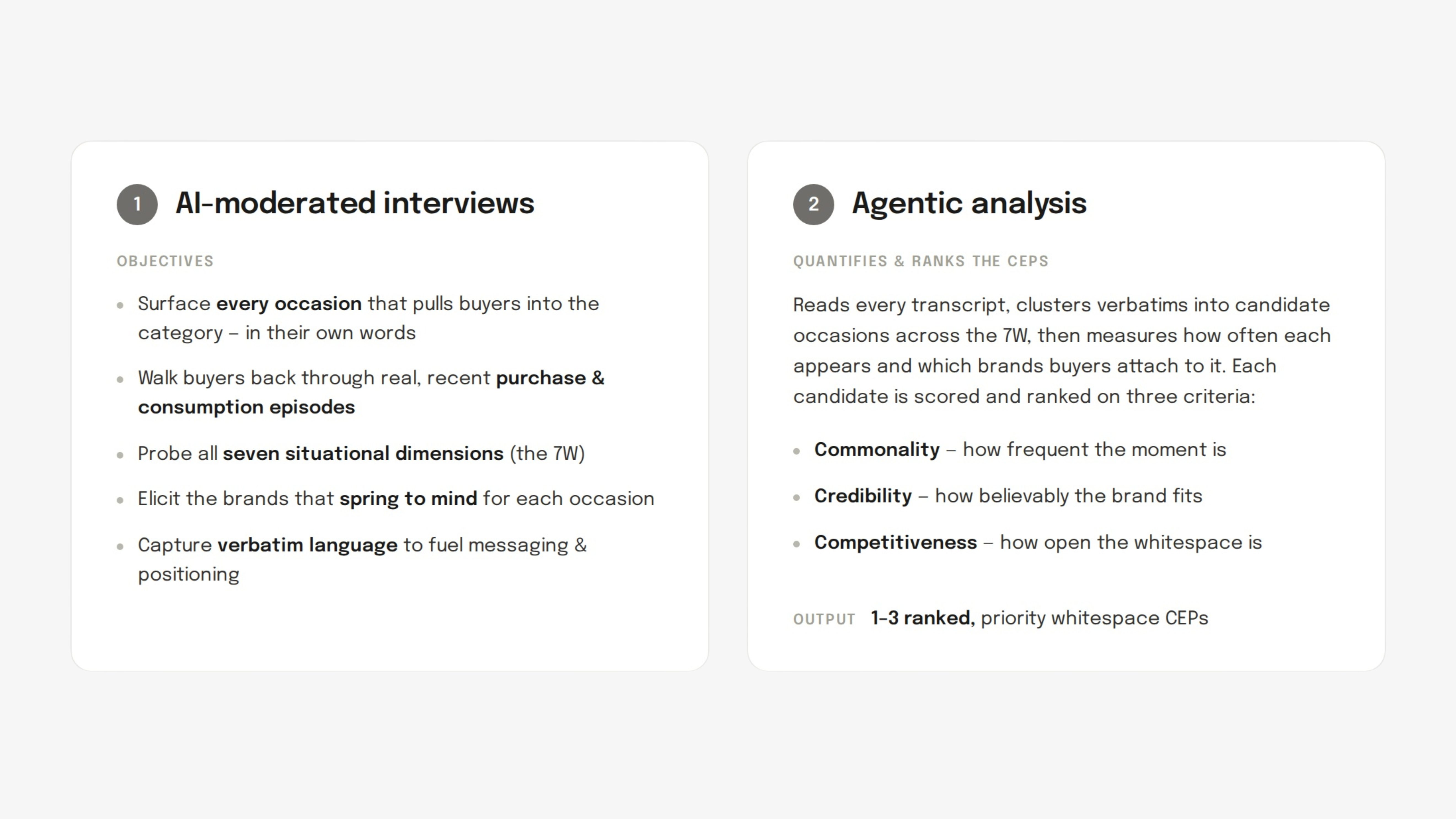
This is the clearest example because the classic approach involves two sequential phases: a qualitative storytelling phase to surface Category Entry Points, followed by a separate quant phase to measure each one. That means two studies, two budgets, and two timelines—usually with two vendors. AI-moderated interviews allow you to run identification and sizing as parallel streams. Conversational interviews surface the situational "why" behind each buying moment at a scale that populates the long tail of CEPs, while agentic analysis ranks them on the same Ehrenberg-Bass metrics agencies bill for: mental market share, network size, and mental penetration. You walk away with a prioritized CEP map (determining which moments to build and which competitors own which doors) in the time it used to take to write the phase-1 debrief. This isn't just a theoretical idea; the field is already using AI to identify CEPs from consumer stories. The leap is doing identification and prioritization in one continuous workflow instead of as two separate engagements.
The pattern is the same for JTBD, segmentation, distinctive brand assets and more. Agency's value came from bundling depth, sizing, and synthesis into something only they could afford to deliver. The method unbundles exactly that.
A fair caveat, as I'm not interested in overselling: this replaces the research production an agency provides, not the strategic judgment of a truly good partner. However, I’m willing to bet that the research agency world will need to evolve rapidly. On this note, Dhruv Guliany is preparing something special for you all - stay tuned.
How is all this changing the CPG/Retail workflow and other methods?
Just as with the airplane metaphor, AI-moderated interviews will evolve our current workflows and the way we utilize traditional research methods. AI-moderation is taking over where speed is essential or where quantitative data falls short.
What’s the moral of the story?
I’d like to invite everyone to experiment, share learnings, and define best practices for this new method together as an industry. By doing so, we can emerge from this disruption with new offerings, stronger businesses, and deeper customer centricity.
Check out my other posts:
- Video Intelligence in AI-moderated research.
- Role of AI in Innovation.
- AI in Brand, Design and Product Strategy.
FAQs
What is AI-moderated research?
AI-moderated research is a method in which an adaptive AI agent conducts open-ended interviews directly with participants, then a second agentic layer synthesizes thousands of those conversations into themes, tensions, and decisions. It is best understood as a distinct hybrid method that sits alongside 1:1 interviews, surveys, focus groups, and Wizard-of-Oz studies, rather than as a faster version of any one of them.
Is AI-moderated research qualitative or quantitative?
Neither, exactly. It is a hybrid that bridges the two. It produces laddered, open-ended "why" data characteristic of qual, but at the sample sizes (n=1,000+) normally associated with quant, which lets you discover what you didn't know and size it in a single study. The advent of large language models creates new opportunities to conduct qualitative interviews at scale and at low cost, with thousands of respondents, thereby bridging qualitative and quantitative methods.
Does AI-moderated research replace qualitative research?
No. It overlaps with qual on certain jobs but does not replace it wholesale. A skilled human moderator chasing a flicker of hesitation, reading tone and body language, and probing the hardest emotional terrain is not yet fully replaceable. The honest framing is method-job fit: for diagnostic "explain the number" work at scale, AI moderation is often the better candidate; for the deepest emotional probing at small n, human qual still wins.
Does AI-moderated research replace quantitative surveys?
Not for every job. For final statistical validation exercises like MaxDiff or conjoint, a graphical survey interface is a better participant experience than a conversation, and structured quant remains the right tool. Where AI moderation competes with quant is in jobs that need both discovery and sizing at once, rather than a known, close-ended question set.
What does AI-moderated research replace, then?
Primarily the research-production layer that agencies and consultancies have historically owned for complex, multi-step studies. AI moderation collapses the cost of depth, agentic analysis collapses the cost of synthesis, and studies can run in parallel rather than sequentially. When those three align, the economic case for the agency middle layer largely evaporates for production work, though it does not replace the strategic judgment of a genuinely good partner.
Is there academic evidence that AI-moderated interviews actually work?
Yes, and the evidence base is growing. In a paper accepted at the Review of Economic Studies, LSE's Friedrich Geiecke and Xavier Jaravel benchmarked AI-led interviews against trained human interviewers across multiple domains. They assess the approach's robustness by drawing comparisons to human experts using several respondent-based quality metrics, and obtain high performance ratings across all four application classes: eliciting key factors in decision-making, political views, subjective mental states, and mental models of public policy. Their human comparison used actual face-to-face interviews conducted by trained sociologists in the LSE Behavioural Lab, and they validated voice mode directly. A separate controlled study by Wuttke and colleagues, published at ACL in 2025, randomly assigned participants to an AI or a human interviewer using identical guides and found comparable data quality with the added benefit of scale.
Is AI-moderated data as rich as data from human interviews?
In the studies run to date, often richer on volume. AI-led interviews revealed more information than conventional open-text fields, with a 142% increase in the number of words respondents wrote. The caveat is depth on the hardest follow-up probes and non-verbal signal: tone, pauses, and body language are largely lost in text and only partially recoverable in voice. So the data is broad and deep on what is said, weaker on what is shown.
What research jobs is AI-moderated research best for in CPG and Retail?
It rates strongest wherever the job is to understand the why, surface consumer language, and explore the unanticipated, and where doing so at scale lets you also size what you find. The highest-value application is diagnostic "explain the number" qual: performance diagnosis, churn drivers, and the "why" behind a concept score. This is precisely the qual most often cut for time at decision gates, and speed-at-scale is what lets it survive the deadline.
When is AI-moderated research the wrong tool?
When the job needs a kind of data a conversation was never going to generate: observed behavior. That includes sales, distribution, cannibalization, findability, sensory delivery, and legal claims substantiation. For these, behavioral, transactional, or in-market data is the right instrument. This is a limitation of the method's data source, not of the agentic analysis quality.
How is AI-moderated research faster and cheaper than traditional methods?
Studies that historically took four to eight weeks now land in days, at a fraction of the spend. The economic shift is not just incremental savings; it changes when research happens. Because the cost and clock are so much lower, teams can run a study before an initiative to inform it, instead of only when the budget justifies a full engagement. That matters most during dynamic disruption, inflation, recession, regulatory or channel shocks, when existing consumer evidence is suddenly invalid and fresh answers are needed on a brutal timeline.
Can AI-moderated research run a full CEP (Category Entry Point) program?
Yes, and this is the clearest example of unbundling. The classic approach runs two sequential phases: a qualitative storytelling phase to surface CEPs, then a separate quant phase to measure each one, usually meaning two studies, two budgets, two timelines, and two vendors. AI moderation lets identification and sizing run as parallel streams: conversational interviews surface the situational "why" behind each buying moment at a scale that populates the long tail of CEPs, while agentic analysis ranks them on the same Ehrenberg-Bass metrics agencies bill for, mental market share, network size, and mental penetration. You finish with a prioritized CEP map in the time it used to take to write the phase-1 debrief. The same pattern applies to JTBD, segmentation, demand-space mapping, distinctive asset development, and white-space discovery.
How should an insights team decide whether to use AI-moderated interviews?
Stop asking whether the method is "good" in the abstract and score its fit against a specific job, on the two dimensions where it genuinely wins or loses: depth-at-scale and speed-at-cost versus the need for observed behavior or human-level emotional depth. Anchor this in the three-level structure of the insights operation, Brand Management, Portfolio Management, and Innovation, and use a Method-Job Fit Map. The fastest way to learn is to run pilots: push vendors to do the setup, then judge the output against the decision you actually need to make.
Curious about what AI-moderated research looks like? Try Keplar here or book a meeting with us here.